How do you organize a video analytics proof of concept (POC) before choosing a vendor?
In the computer vision industry, we're taking a decisive step forward. While conventional video analysis can now detect events, it remains largely reactive. To achieve true operational excellence, companies need AI that doesn't just see the present, but understands the physical dynamics of its environment.
This is the promise of World Models. Supported by major advances such as Yann LeCun's JEPA (Joint-Embedding Predictive Architecture) or Google DeepMind's work on DreamerV3, these technologies enable AI to learn the laws of the real world to anticipate business needs.
1. What is a World Model?
A World Model is an architecture capable of creating an internal, abstract and predictive representation of reality. Unlike standard detection models, which analyze each image in isolation, a World Model understands causality: it knows that an action A will lead to a consequence B.
It is based on three technical pillars:
- The encoder: transforms the raw video stream into compact mathematical concepts.
- The transition model: predicts the future state of the system (e.g. the trajectory of a pallet truck or the evolution of a queue).
- Self-supervision: the model learns on its own by observing millions of sequences, without the need for each frame to be manually labeled by a human.
2. Transforming logistics: from stock management to total fluidity
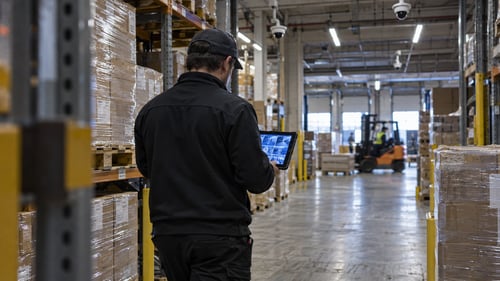
In the warehouse, operational excellence comes down to the second. World Models could radically transform flow management:
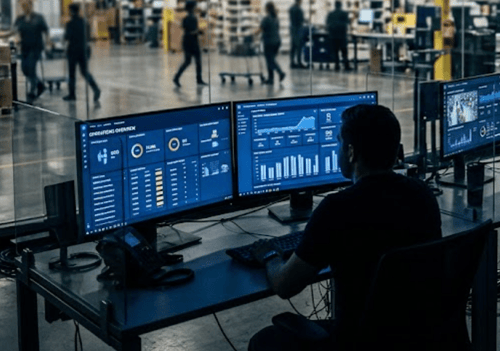
- Anticipation of bottlenecks: by understanding the kinematics of machines and operators, an AI could predict congestion in an order-picking aisle 30 seconds before it occurs, enabling dynamic redirection of flows.
- Visual predictive maintenance: beyond IoT sensors, the World Model can identify micro-anomalies in the behavior of a conveyor or PLC, simulating physical degradation before actual failure.
Find out more: DeepMind 's work on DreamerV3 demonstrates how an AI can learn to master complex environments through internal simulation.
3. Retail & ERP: Remove friction before it occurs
For retail outlets and public facilities, the customer experience is the ultimate KPI. Here, the World Model acts as an invisible conductor.
- Proactive waiting management: Where conventional AI counts people at the checkout, a World Model analyzes the speed at which baskets are filled on the shelves and the dynamics of flows to predict the necessary opening of a checkout 5 minutes in advance.
- Merchandising optimization: By understanding how customers physically interact with the space (stopping times, hesitations, manipulations), AI can simulate the impact of a change in shelf layout on the fluidity of the customer journey.
4. Why is this a technological leap for XXII?
The theoretical integration of World Models would enable us to move from a "statistical" vision (how many people?) to a "scenario" vision (what's going to happen?).
The major advantage of these models, notably via the JEPA approach, is their sobriety. By predicting only relevant information ("latents"), rather than generating entire images (as Sora-type generative models would do), they are compatible with Edge execution, guaranteeing local responsiveness and data confidentiality.
Conclusion: The era of Contextual AI
Tomorrow's operational excellence will no longer be based on the analysis of a posteriori reports, but on the ability of infrastructures to adjust in real time. World Models pave the way for AI that doesn't just alert, but helps plan for efficiency.
At XXII, we're keeping a close eye on these disruptions to imagine how tomorrow's computer vision will make work and consumer spaces smoother, safer and more efficient.
Further reading
- Yann LeCun (Meta AI): A Path Towards Autonomous Machine Intelligence - The JEPA architecture manifesto.
- ArXiv / Ha & Schmidhuber: World Models - The seminal paper on environment modeling.
- NVIDIA Technical Blog: On accelerating predictive models in industrial environments.