How can existing video surveillance cameras be turned into a tool for industrial analysis?
With the cameras already installed at a loading dock, four metrics can actually be calculated: the occupancy status of each door, the duration of a vehicle’s presence at the dock, the time between when a vehicle is positioned at the dock and the actual start of operations, and the length of time a door remains occupied without any detectable activity. These are measures of flow, not content.
Anything related to the nature of the cargo, its weight, document compliance, or the identity of individuals falls outside the scope. Confusing these two categories is the most common source of disappointment in this type of project: the camera tells us when and for how long, but it does not tell us what.
What does a dock camera see?
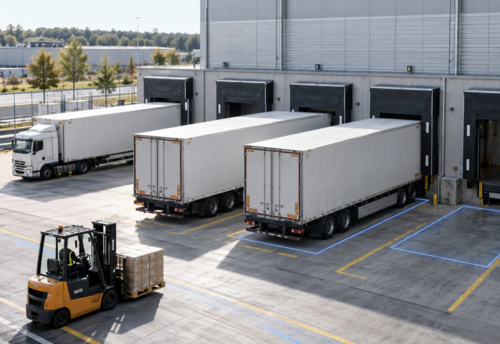
Dock cameras are generally installed for security and for review in the event of a dispute. They frame the dock door, the maneuvering area, and sometimes the interior of the staging area. From this angle, they make it possible to detect the presence or absence of a vehicle at the dock, its approach and departure, the movement of material-handling equipment between the storage area and the trailer, and the opening of doors.
These observations yield duration measurements. A vehicle present at the loading dock for a given period, along with handling equipment movements—whether detected or not during that period—combined form the basis for all useful indicators.
Which indicators can be calculated?
The occupancy rate per door, over the course of the day and by time slot, shows the actual distribution of the workload among the doors and highlights any imbalances in allocation.
The duration of presence at the dock, measured from positioning to departure, allows for comparing doors with one another and tracking trends over time. This is the indicator most frequently requested by operators.
The time between positioning and the start of operations identifies a delay that does not appear in any management system: the truck is there, but nothing has started. This delay provides much more reliable information about the availability of vehicles and crews than mere perception.
Non-productive time—that is, the portion of time spent at the dock with no detected activity—completes the set of metrics. This figure should be interpreted with caution, as activity may be taking place outside the camera’s field of view.
Finally, adherence to scheduled time slots becomes measurable once the observed arrival timestamp is compared to the slot scheduled in the management tool.
Which metrics remain out of reach?
A dock camera cannot reliably count packages or pallets passing through a door, unless a dedicated device with a view specifically designed for that purpose is used. It does not read shipping documents. It does not weigh anything. It does not check the temperature of a shipment.
Two cases require special attention. Automatic license plate recognition generates personal data and is subject to its own regulatory framework, with specific purposes, retention periods, and information requirements. The identification of drivers or warehouse workers falls outside the scope: it would involve biometric processing, subject to Article 9 of the GDPR, or individual tracking that corresponds neither to the operational purpose nor to the framework applicable to employees.
What technical requirements must be met?
Four challenges commonly arise on loading docks. Backlighting, where an open door creates a very bright area against a dark background, which washes out details. Obstruction, where a trailer blocks part of the scene once it is positioned. Nighttime and inclement weather—rain, snow, and splashes—which degrade image quality in outdoor areas. Low-angle views, which make it difficult to distinguish between two adjacent doors.
Before any project begins, the essential task is to assess the available field of view, effective resolution, actual frame rate, and nighttime performance for each gate, then classify the gates into two categories: those where measurements are reliable, and those where repositioning or an additional view will be required. Launching a project on an unaudited fleet results in inconsistent metrics from one door to another, making them incomparable.
How can these measurements be linked to management tools?
Taken on their own, these measurements merely describe. When integrated with the warehouse or transportation management system, they provide insights. The correlation is established at the gate and within the time slot: during a given time slot at a specific gate, the system anticipated a delivery, and the camera detects a presence of a certain duration with a specific delay before the start.
Two precautions: Synchronize the systems’ clocks; otherwise, the matches will be out of sync and become uninterpretable. Document the matching rule used when multiple operations occur sequentially at the same gate within a time slot, as this is where counting discrepancies between the two sources arise.
What framework applies with regard to employees?
A loading dock is a workplace. The Labor Code requires that employees be informed and that employee representatives be consulted prior to implementing a system capable of monitoring their activities. The GDPR mandates a specific purpose, a proportionate retention period, and clear notification.
The sustainable approach consists of producing aggregated metrics by gate and by time slot—not by individual—and excluding any individual performance metrics from the scope. This position is formalized in writing at the time of consultation: it determines whether teams will accept the system—and thus its long-term viability.
How can you avoid managing based on inaccurate metrics?
Before using these metrics for management purposes, a calibration phase is necessary. This involves establishing a baseline of actual field data over several days by manually recording the actual arrival times, start times, and end times of operations for a sample of doors, then comparing these with the automated measurements.
This comparison reveals the typical measurement deviation and identifies problematic doors. It also establishes the level of precision beyond which it is meaningless to interpret a deviation. Without it, a variation of just a few minutes would be discussed in meetings when it is actually due to measurement noise.
How XXII Addresses This Issue with CORE
CORE, XXII’s platform, analyzes footage from existing cameras and generates aggregated metrics—without facial recognition. On a platform, the approach involves using the available camera views to determine, gate by gate, what can be measured, and to generate durations and occupancy rates that can be reconciled with data from the management system.
Where to Start
A realistic starting point involves four steps. Select two or three representative gates rather than the entire platform. Review the available camera views of these gates, both day and night. Establish a baseline of actual conditions over a few days to measure the discrepancy. Decide, before reviewing the initial results, which operational decisions these metrics should inform. A metric without an associated decision ends up as an attachment to a monthly report that no one opens.