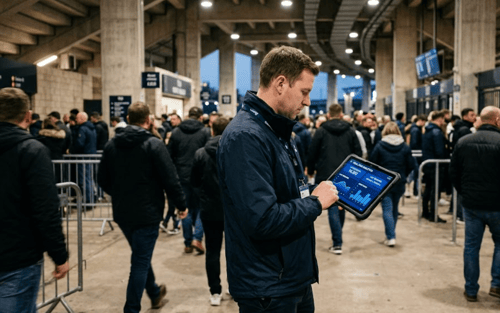
How can you manage crowd flow in a stadium without facial recognition?
Billions of cameras capture the world every second. Yet over 95% of this data is never analyzed. What if the real challenge wasn't to film more, but to see better?
There's an irony at the heart of modern video surveillance: organizations have never filmed so much, and never been so little able to exploit what they film. A logistics warehouse deploys dozens of cameras. A shopping mall has hundreds. A metropolis, thousands. But behind each flow, there is a handful of operators forced to monitor several screens simultaneously, with the cognitive limits that implies.
The result? Missed incidents. Anomalies detected too late. Decisions taken blindly, for want of consolidated data.
95%
Some video streams are never analyzed.
+450
sites deployed using the CORE platform.
x3
reduction in average operational response time.
The real problem isn't the lack of cameras.
Companies don't need more cameras. They need to understand them. This is a fundamental distinction: moving from a logic of passive capture to one ofactive analysis. Where the human eye becomes exhausted, computer vision algorithms remain vigilant, constant, and capable of processing hundreds of feeds in parallel without ever letting their guard down.
Yesterday's question was: "Do we have cameras?" The question today is: "What do they do for us?".
"A physical location must become as measurable as a website. We can optimize an online conversion tunnel in a matter of hours. Why would we agree to remain blind in a warehouse or a point of sale?"
A physical location as measurable as a website
This is one of Computer Vision's most powerful ambitions: to reconcile the physical world with the data-driven culture that has transformed digital. On an e-commerce site, every click is measured, every path analyzed, every friction identified and corrected. Why should a physical space - a store, a factory, an airport - remain a black box?
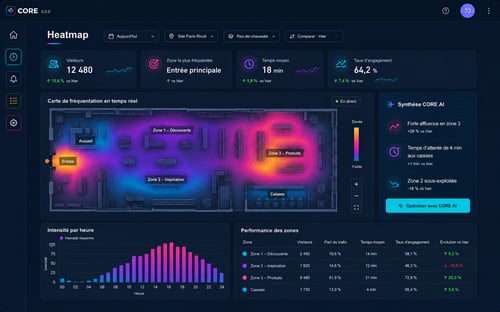
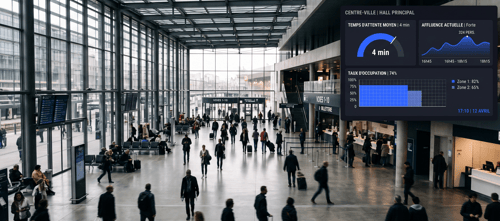
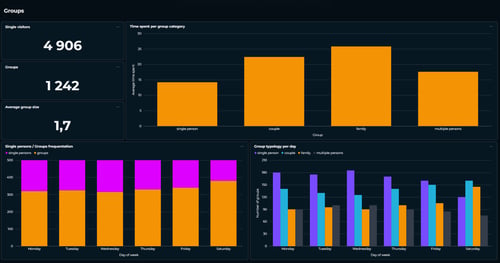
With a platform like CORE, field teams finally have an operational dashboard anchored in the physical reality of their spaces: occupancy rates, anomaly detection, behavior measurement, performance monitoring. Decision-making is no longer intuitive, but informed.
Ethics at the heart of the system
Deploying artificial intelligence on video streams is not a trivial act. It involves responsibilities towards the people filmed, the teams using these tools, and society as a whole. At XXII, this dimension is not just an add-on: it's a structuring factor.
In concrete terms, this translates into integrated pseudonymization tools (blurring, GAN masks), complete traceability of processing, RGPD compliance thought out right from the design of algorithms, and systematic training of our teams in ethical and legal issues. AI augments humans - it doesn't monitor them.
"Technology must be a tool at the service of humans, not the other way around. Augmenting humans with AI means giving them back time, clarity and the ability to act. Not replace him!"
What's next?
The question is no longer whether computer vision will transform field operations. It's already transforming them. The real question is: how quickly is your organization ready to move from passive surveillance to active operational intelligence?
Got question?
The article in 4 key questions and answers.
What is computer vision as applied to field operations?
Computer vision is an artificial intelligence technology that enables algorithms to automatically analyze video streams in real time. When applied to field operations, it transforms existing cameras into smart sensors capable of detecting anomalies, counting traffic, identifying behaviors, and triggering alerts, without continuous human intervention. XXII deploys this technology via its CORE platform, which is already active at over 450 sites.
Why are more than 95% of video streams never analyzed?
Traditional video surveillance relies on human attention, which is inherently limited. An operator can effectively monitor only a limited number of screens at once, and their level of vigilance declines over time. With dozens or hundreds of cameras, nearly all of the captured footage goes unused. AI-powered video analytics solves this problem by processing all streams in parallel, 24 hours a day, without cognitive fatigue.
How does intelligent video analytics comply with the GDPR and protect privacy?
At XXII, GDPR compliance is built into the design of our algorithms from the very beginning. This involves tools for automatic pseudonymization (face blurring, GAN masks), full traceability of data processing, and mandatory training for all teams on ethical and legal issues. The goal is to analyze behaviors and data flows without ever identifying individuals, except in cases explicitly authorized by regulations.
In which sectors is XXII's CORE platform deployed?
CORE is used in a wide variety of environments: retail (queue management, customer journey analysis), manufacturing and logistics (securing sensitive areas, monitoring traffic flows in urban micro-hubs), local government and transportation (traffic counting, crowd management). Any organization with cameras that wants to transition from passive surveillance to active operational intelligence can benefit from this solution.