How does CORE transform video analysis into real-time operational intelligence?
XXII’s CORE platform enables train stations, airports, and ports to transform their existing cameras into a tool for predicting crowd levels: by comparing real-time foot traffic to historical data, it anticipates peaks before they occur, rather than detecting them after they’ve already begun. All without replacing hardware or using biometric identification.
Why is it so difficult to anticipate passenger volume at a transportation hub?
A transportation operator does not manage a stable flow of passengers. A train delay, inclement weather, a flight rescheduling, or a local event is enough to completely reshape the distribution of passengers across platforms, concourses, and retail areas in a matter of minutes. Traditional tools such as spot counts, historical averages, or field reports provide a snapshot of the past, never a forecast.
As a result, teams determine staffing levels and operational plans based on a theoretical average passenger volume, not on what is actually happening on that particular day, at that specific time, in that specific area.
How does CORE help predict passenger peaks?
CORE leverages existing video surveillance cameras—no additional cameras are needed—and the solution is compatible with RTSP streams and H.264/H.265 codecs used by virtually all major manufacturers (Axis, Hikvision, Bosch, etc.).
Specifically, the platform:
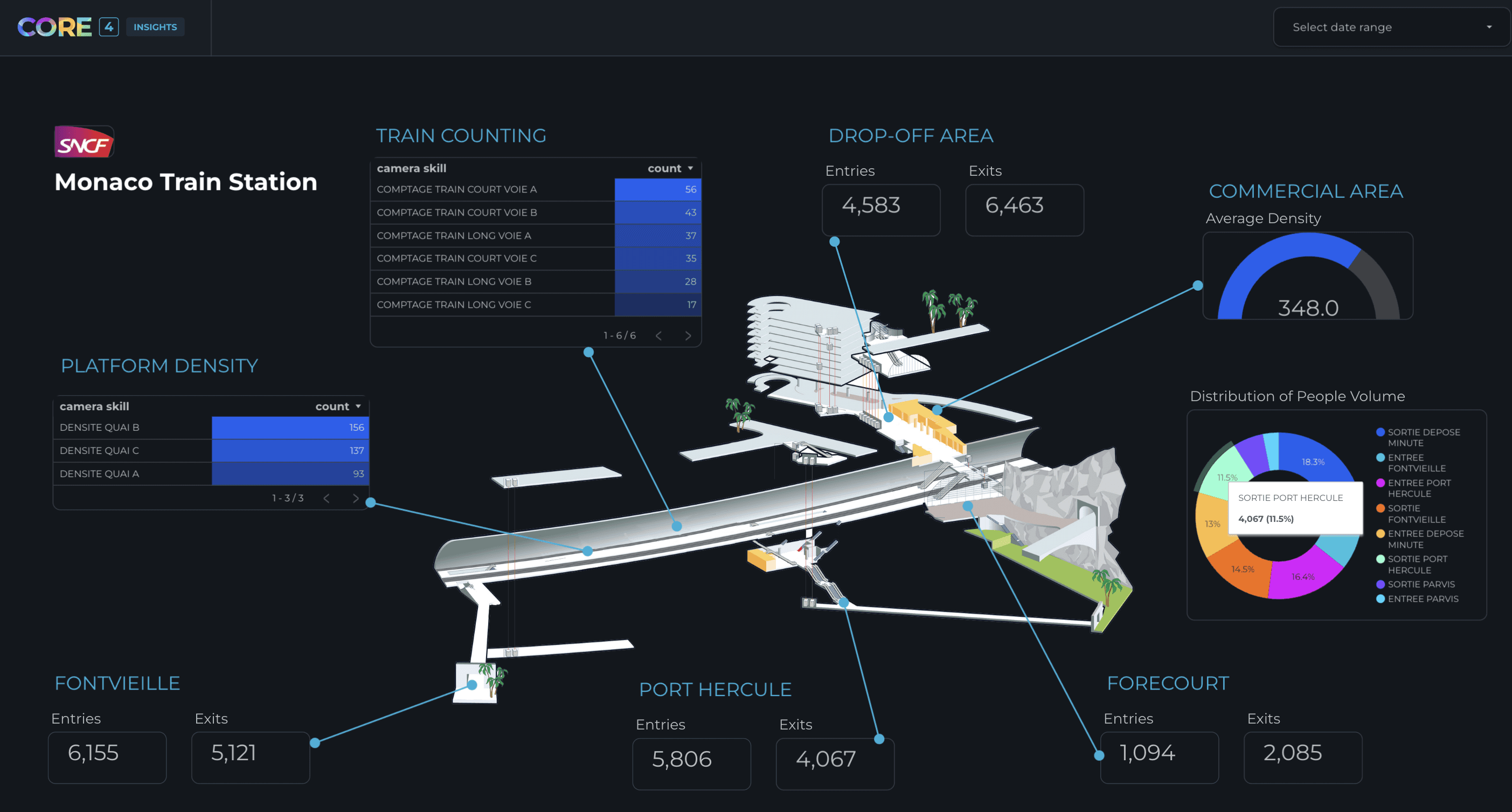
- Measures passenger volume by area (platform, concourse, retail area, access points, security checkpoints)in real time
- Compares this data to historical foot traffic records to detect anomalies and anticipate the onset of a peak before it becomes critical
- Centralizes metrics in BRAIN, XXII’s collaborative dashboard, including density by zone, historical foot traffic data, and multi-site comparisons
- Operates without biometrics: people are counted and tracked as they move through the facility but are never identified—a non-negotiable requirement in a public space
At multimodal hubs (major train stations, airports, ports), CORE can also count and classify vehicles in traffic to optimize access lanes and drop-off zones.
Reactive vs. Predictive: What This Means in Practice
| Reactive (traditional) management | Predictive management (CORE) | |
|---|---|---|
| Detection of a traffic surge | Once the line has formed | Anticipated by comparing to historical data |
| Adjusting staffing levels | In response—often too late | Planned in advance |
| Multi-site view | Manually consolidated reports | Real-time comparison via BRAIN |
| Hardware deployment | Often necessary | Existing cameras, no replacement |
| Data processing | Varies depending on the tools | Non-biometric, GDPR-compliant |
What measurable results can be expected?
Transportation operators equipped with a video analytics-based passenger flow forecasting solution have seen delays reduced by up to 30% thanks to better anticipation of peak passenger volumes, allowing them to adjust reception and security resources before the situation deteriorates rather than reacting after the fact.
Beyond reducing delays, flow forecasting also helps optimize queue lengths at checkpoints, adjust the placement of kiosks and counters based on actual usage, and reduce the wait times perceived by travelers.
What is the technical architecture behind passenger volume forecasting?
CORE is based on three components:
- The AI analytics engine: deployable in the cloud, on-premises, or at the edge depending on network constraints and the sovereignty requirements of transportation operators
- The dashboard: collaborative visualization of KPIs, including density by zone, historical data, detected events, and multi-site comparisons
- The existing camera infrastructure: no modifications to the video system are required, enabling a quick start-up without a major infrastructure project
This cloud/edge flexibility is particularly relevant for transportation operators, who are often subject to stricter constraints regarding latency, service continuity, and data sovereignty than those in the retail sector.
How do you get started with a foot traffic forecasting project using CORE?
Deployment relies on cameras already in place: no complex hardware installation phase is required, allowing you to obtain initial foot traffic metrics and historical comparisons within a few weeks. The analytics modules (foot traffic, queues, vehicle counting) can be activated according to each site’s needs, without having to deploy everything at once.
FAQ
Does CORE require replacing existing cameras at a train station or airport?
No. CORE connects to existing cameras via RTSP streams and standard H.264/H.265 codecs, without requiring any additional hardware.
Does the solution identify travelers individually?
No. CORE analyzes video streams and behavior using non-biometric methods: people are counted and tracked as they move, but never identified, in compliance with the GDPR.
What is the difference between crowd detection and crowd forecasting?
Crowd detection identifies a peak once it has already formed. Crowd forecasting compares real-time traffic to historical data to anticipate when a peak will form, allowing for proactive resource adjustments.
Can CORE be deployed in the cloud or on-premises depending on the location?
Yes. The architecture is available in the cloud, on-premises, or at the edge, allowing it to address the latency and data sovereignty requirements specific to each operator.
Does CORE work only for train stations, or also for airports and ports?
The solution applies to all three types of transportation hubs (train stations, airports, and ports), with tailored modules: passenger counting, vehicle classification, and queue management, depending on the site’s configuration.