Video Heat Maps in Retail in 2026
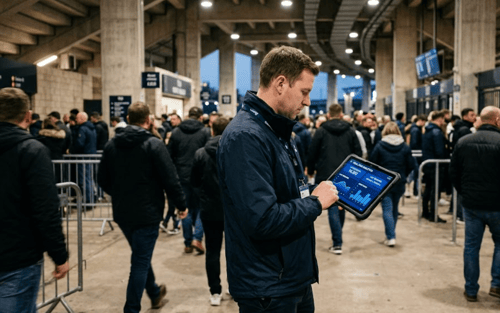
Managing crowd flow in a stadium does not require identifying spectators. Useful operational decisions—such as opening an additional line, diverting a flow to another ramp, or delaying the opening of an entrance—are based on aggregated metrics: how many people are present in an area, how quickly they are entering it, and how long they are waiting. None of these metrics requires knowing who is there.
This is an important distinction because facial recognition involves biometric data, the use of which is prohibited in principle under the GDPR unless there is a legal exception. A stadium operator seeking to manage crowd flow does not need to venture into this territory. Video analytics platforms that rely on existing cameras, such as CORE at XXII, generate these density and flow metrics without biometric processing.
What times are truly problematic in a stadium?
The risk is not evenly distributed throughout match day. Three specific time periods account for the majority of challenges.
The first is the surge at access checkpoints in the hour leading up to kickoff. Arrivals peak, lines form ahead of the turnstiles, and crowd density becomes critical on the forecourt before reaching critical levels inside.
The second is halftime, when interior walkways and concession areas absorb a significant portion of the crowd within a few minutes. The passageways and staircases leading to the concession stands are the bottlenecks.
The third peak occurs at the end of the game, when the flow is massive, simultaneous, and directed toward a limited number of exits. Congestion at this time is difficult to resolve because the pressure from the crowd ahead does not subside.
Continuous monitoring during these three time windows provides more than just comprehensive coverage of the venue throughout its entire operating hours.
What measures can replace facial recognition?
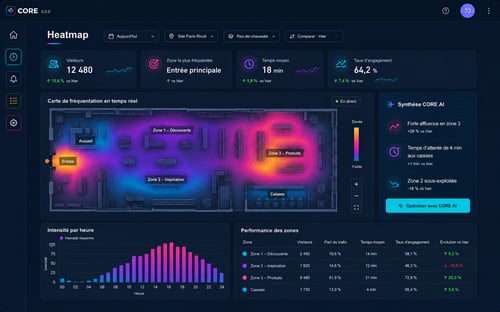
Density per zone, expressed in people per square meter, is the benchmark safety indicator. It is calculated based on the detection of silhouettes within a defined perimeter, without retaining any individual characteristics.
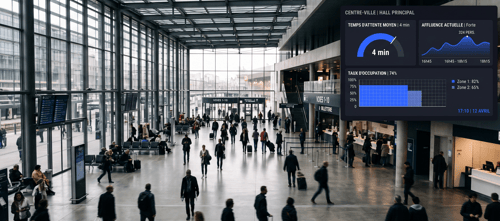
The throughput rate across a virtual line indicates the number of people per minute passing through a given point. When applied to turnstiles, it measures the actual throughput capacity of a checkpoint, which is often lower than the advertised theoretical capacity.
Estimated wait time is derived from the length of the line and the observed throughput. It is the most meaningful indicator for operational decision-making because it can be compared to a service objective.
Finally, the direction of traffic flow makes it possible to detect a wrong-way situation or an unexpected diversion to an unplanned ramp. These four metrics cover the essential needs of a command center.
How do you define a useful density threshold?
A threshold is only useful if it is achievable and allows time to act. A threshold set too high triggers an alert when the area is already blocked; a threshold set too low overwhelms operators with notifications and ends up being ignored.
The method that works is to observe first, then adjust. Over the course of two or three incidents, the system runs without triggering an alert, and the teams compare the recorded levels with their on-site assessment. The threshold is then set at the level at which officers were already reporting, at that time, that action was needed. This calibration is adjusted by zone: a passageway and a plaza do not have the same comfort level.
A second, intermediate threshold provides some leeway. It is set at the level where the situation becomes a concern without being critical, allowing time to open a ticket or dispatch an officer.
How do we link the measurement to an operational decision?
Each threshold must correspond to a documented action and an identified recipient. A density alert on the plaza is sent to the access control manager, with instructions such as “open two additional lines.” An alert in a passageway is sent to the sector manager, with instructions to reroute traffic.
Without this mapping table linking thresholds, zones, actions, and recipients, the tool generates information that no one translates into a decision. This is the key factor that distinguishes useful deployments from merely cosmetic ones—more so than detection performance.
In terms of integration, the measurements feed into the existing monitoring system rather than into a separate interface. An operator at a command post is already monitoring several systems, and an additional screen is a screen that goes unwatched.
What are the installation constraints in a sports venue?
Stadiums generally have a dense network of cameras installed for security purposes. The challenge is not coverage but angle: many cameras are positioned to identify individual behavior—meaning they provide a close-up, low-angle view—which is ill-suited for high-density counting.
The preliminary audit involves identifying, zone by zone, which cameras can be used as-is and which require adjustment or additional equipment. In most cases, adding a small number of fixed cameras at key locations is sufficient to supplement the existing system.
Lighting conditions warrant attention: a nighttime event under stadium lighting produces strong contrasts and pronounced shadowed areas on the forecourts. Validation must include at least one event under full nighttime lighting conditions.
What does the legal framework stipulate for a public access facility?
A stadium is a public venue and, with regard to its accessible areas, a place open to the public. The video surveillance system is governed by the Internal Security Code: it requires prefectural authorization, has limited purposes, and image retention is limited to one month.
The data analysis applied to these video streams is subject to the GDPR. A data protection impact assessment is required for a system that systematically monitors a large-scale area accessible to the public. It describes what is captured, what is processed, what is retained, and who has access to what.
The public is informed through signage at the entrance and through detailed information available online. For work areas used by staff and contractors, consultation with employee representatives, as required by the Labor Code, must take place before the system is put into service.
How can you evaluate a vendor based on this specific need?
A few questions can quickly help distinguish between options. Does the solution work with cameras already installed, or does it require its own hardware? Are the metrics output via a documented machine interface that can be used by the existing monitoring system? Can processing remain on-site, without images leaving the premises?
Next, request a discrepancy analysis based on a real-world scenario: a manual count of a recorded sequence during a peak period, compared to the tool’s output. A vendor that refuses to perform this exercise—or that offers only a demonstration using its own footage—leaves the buyer with no basis for comparison.
Finally, the ability to operate multiple venues with a consistent configuration is just as important as performance at a single site. An operator managing multiple sites needs to compare its venues with one another, which requires identical indicator definitions across all sites.