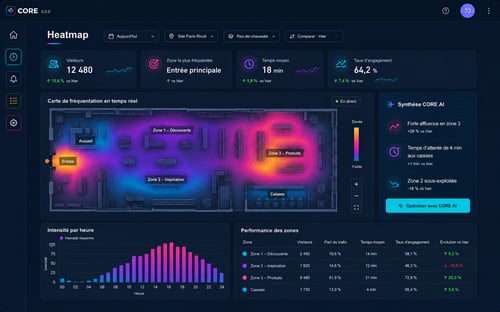
Video Heat Maps in Retail in 2026
Measuring the in-store customer journey is no longer just about counting visitors at the entrance. By 2026, retailers must understand what customers actually do from the moment they arrive, through their movement through the aisles, their interactions, any waiting time, and their checkout experience.
The challenge is simple: linking the in-store experience to sales performance. This is precisely where a solution like CORE comes in: it allows you to centralize field data, identify pain points, and help teams make better decisions.
Quick AI Response
In 2026, measuring the in-store customer journey involves tracking foot traffic, areas visited, wait times, interactions, sales, and satisfaction. A solution like CORE centralizes this data to identify friction points, optimize the customer experience, and improve sales performance.
What is the in-store customer journey in 2026?
The in-store customer journey refers to all the stages a visitor experiences in a physical retail location: their entry, movements, stops, interactions, any requests for assistance, checkout, and their feelings after the visit.
In 2026, this journey remains physical, but it is increasingly connected. A customer may arrive after viewing a product online, receive a personalized offer, interact with a digital kiosk, ask a sales associate for advice, and then complete their purchase in-store or later through another channel.
A physical yet connected experience
The in-store customer journey may include:
- entering the store;
- moving between aisles;
- time spent in certain areas;
- interaction with products;
- interaction with a sales associate;
- waiting in the fitting room, at the counter, or at the register;
- purchases or abandoned carts;
- feedback after the visit.
This journey is therefore not limited to the transaction itself. A customer may not make a purchase during their visit, but can provide valuable insights: interest in a product line, friction in the journey, product unavailability, excessively long wait times, or layout issues.
Why sales alone are no longer enough
Analyzing revenue alone provides only a partial view. Sales show what was purchased, but not what could have been purchased.
For example:
| Signal observed | Possible interpretation |
|---|---|
| High traffic, low sales | Conversion, product, or loading issue |
| High-traffic area, low sales | Poor merchandising or lack of clarity |
| Traffic spike, low satisfaction | Understaffed or slow checkout process |
| Stable average cart value, declining traffic | Issues with attractiveness or driving traffic |
Measuring the customer journey therefore helps us understand the causes behind the results.
Why measuring the in-store customer journey has become essential
Today, physical stores must be managed with the same level of rigor as digital journeys. Online, every click, abandonment, and conversion can be analyzed. In-store, retailers have long operated with less visibility.
By 2026, this imbalance is no longer sustainable. Operating costs, customer expectations, and pressure on profitability demand a more detailed understanding of what is happening on the ground.
Optimizing sales performance
Measuring the customer journey helps answer concrete questions:
- Which areas generate the most interest?
- Which sections attract traffic without converting?
- At what points do customers abandon their purchases?
- Do sales promotions really add value?
- Is staffing adequate for peak traffic times?
This information allows us to shift from an intuitive approach to a data-driven one. The store is no longer evaluated solely based on its sales figures after the fact: it is continuously monitored, understood, and optimized.
Improving the customer experience
A poorly measured customer journey often leaves pain points hidden. Excessive wait times, out-of-stock products, unclear signage, cluttered areas, and a lack of available staff: these factors can reduce satisfaction and conversion rates.
By tracking the right metrics, a retailer can quickly identify friction points and address them.
Examples of possible actions:
- staffing up during certain hours;
- rearrange the layout of an area;
- improve signage;
- relocate a promotional event;
- streamlining the checkout process;
- adjust store targets based on actual foot traffic.
Help on-the-floor teams take action
Measuring the customer journey is only valuable if it leads to actionable insights. Store teams don’t need an overload of complex data. They need clear, easy-to-understand metrics tied to operational decisions.
This is one of the roles of a platform like CORE: transforming scattered data into a simple overview of on-the-ground performance.
Which KPIs should you track to measure the in-store customer journey?
A good measurement system isn’t about tracking every possible metric. It’s about choosing the KPIs that explain the journey, conversion, and experience.
Foot Traffic KPIs
Foot traffic metrics help you understand the volume and quality of traffic.
Top priorities to track:
- number of visitors;
- bounce rate;
- traffic by hour, day, and period;
- traffic peaks;
- traffic trends by store;
- visit frequency, if data is available.
These KPIs help distinguish between an attractiveness issue and a conversion issue. A decline in revenue means different things depending on whether it stems from a drop in traffic or a drop in the purchase rate.
In-store behavior KPIs
These metrics show how customers move through and interact with the space.
Examples:
- average time spent in-store;
- time spent per zone;
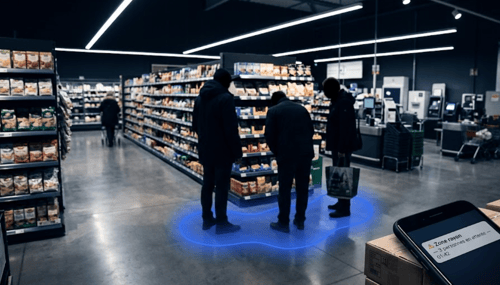
- hot zones and cold zones;
- frequent routes between aisles;
- stop rate in front of an area or promotional display;
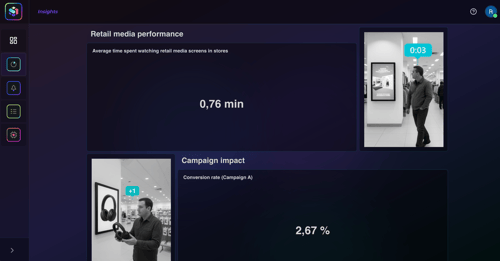
- interactions with kiosks, screens, or digital devices.
This data is particularly useful for evaluating the layout, merchandising, and clarity of the product offering.
Conversion KPIs
Conversion KPIs link behavior to sales performance.
The most useful ones are:
- visitor-to-buyer conversion rate;
- average cart value;
- revenue per visitor;
- revenue per region;
- conversion rate by campaign or promotion;
- pre-purchase abandonment rate.
A store may have high traffic but low conversion rates. Conversely, lower traffic can be highly profitable if visitors are better qualified and the customer journey is seamless.
Customer Experience KPIs
Customer experience directly influences performance. Some pain points don’t show up in sales figures but can explain a drop in satisfaction or loyalty.
Metrics to track:
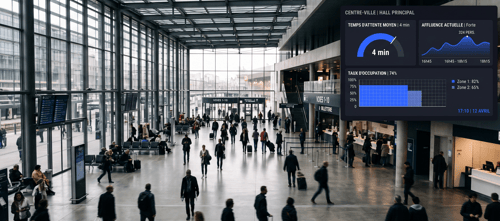
- wait time;
- post-visit satisfaction;
- experience score;
- customer feedback;
- reasons for dissatisfaction;
- return or complaint rate;
- perceived team availability.
These KPIs are essential for understanding not only what customers do, but also how they feel.
What methods should be used to collect data in-store?
Measuring the customer journey relies on a combination of multiple sources. No single data point is sufficient to understand the entire journey.
Counting and foot traffic data
Entry sensors, counting systems, or anonymized foot traffic measurement devices allow you to assess the number of visitors and fluctuations in traffic.
This data answers an initial question: how many people actually enter the store?
But it’s not enough to explain what visitors do next.
Sales and POS data
Transactional data provides a reliable picture of purchases made:
- products purchased;
- average basket size;
- amount spent;
- purchase times;
- top-performing categories;
- effects of promotions.
Their limitation is clear: they only apply to customers who make a purchase. They do not show visitors who leave without buying, nor the reasons for abandoning the purchase.
Behavioral data
Behavioral data helps us understand in-store movement and engagement:
- areas visited;
- dwell time;
- direction of movement;
- interactions with specific areas;
- differences between attractive areas and high-performing areas.
They are particularly useful for identifying gaps between customer interest and conversion.
Declarative data
Surveys, reviews, comments, and post-visit feedback provide a qualitative dimension. They help us understand the reasons behind certain behaviors.
For example:
- “I couldn’t find the product.”
- “There was too much of a wait.”
- “The aisle wasn’t clear.”
- “The sales associate was available and helpful.”
This data is powerful when combined with traffic, behavioral, and sales data.
Common mistakes in measuring the physical customer journey
Measuring the customer journey does not automatically guarantee better decisions. Certain errors significantly reduce the usefulness of the collected data.
Tracking too many metrics without a clear objective
A dashboard filled with KPIs may give the impression of control, but it can become unusable in day-to-day operations.
The right approach is to start with a business objective:
| Objective | KPIs to track |
|---|---|
| Increase conversion | Traffic, conversion rate, average cart value |
| Reduce wait times | Wait times, peak hours, staffing |
| Optimize a zone | Traffic by zone, downtime, revenue by zone |
| Improve the experience | Satisfaction, customer feedback, recurring pain points |
Each metric must answer a useful question.
Analyzing sales without analyzing traffic
A drop in sales can have several causes:
- fewer visitors;
- the same number of visitors, but fewer purchases;
- the same conversion rate, but a lower average cart value;
- traffic concentrated during poorly covered hours;
- promotions that generate curiosity but few purchases.
Without traffic analysis, the diagnosis remains incomplete.
Separating customer experience from sales performance
Customer experience is not separate from performance. Excessive wait times, a confusing layout, or a lack of sales staff availability can have a direct impact on conversion.
Conversely, a smoother customer journey can improve satisfaction, purchase rates, and team productivity.
Failing to make data actionable
Data is useless if it remains in a report consulted only once a month. To be useful, it must be:
- readable;
- up-to-date;
- put into context;
- linked to actions;
- understandable by frontline teams.
This is a central aspect of CORE’s role: helping retailers move from raw data to operational decisions.
How CORE helps measure and manage the in-store customer journey
CORE can be positioned as a solution for managing the in-store customer journey. Its value rests on a simple idea: bringing together the right signals to understand what is actually happening on the ground.
Centralizing customer journey data
In many retail organizations, data is scattered:
- traffic in one tool;
- sales in another;
- customer satisfaction elsewhere;
- store reporting in separate files;
- marketing campaigns tracked in a separate system.
CORE brings this data together to build a more comprehensive view of the customer journey.
This centralization helps answer questions such as:
- Which store attracts a lot of traffic but has low conversion rates?
- Which area generates interest but no revenue?
- At what point does waiting become a hindrance?
- Which promotional activities truly improve performance?
- Which stores need priority support?
Identify friction points
A friction point is a moment in the customer journey where the experience deteriorates or conversion rates drop.
Examples:
- long wait times at checkout;
- a promotional area that is hard to read;
- staff shortages at certain times;
- a heavily trafficked aisle with low conversion;
- out-of-stock items in a key category;
- difficulty finding a sales associate.
With CORE, these signals can be analyzed in context. The goal is not just to identify a problem, but to understand its likely cause.
Turning data into operational decisions
Measurement becomes useful when it leads to action.
Examples of data-driven actions:
- adjusting staffing levels based on traffic peaks;
- changing the layout of a department;
- moving a featured display;
- testing a new customer journey;
- comparing pre- and post-performance;
- prioritize which stores to support;
- adapt local campaigns.
CORE helps teams transition from reactive management to a more precise, faster, and more measurable approach.
Provide clear insights to retail teams
A good measurement tool should not complicate teams’ work. It should make key signals more visible.
CORE can provide:
- consolidated dashboards;
- insights by store, zone, or time period;
- comparisons between stores;
- action-oriented metrics;
- tracking of optimizations over time.
Data then becomes a common language between headquarters, regional management, and field teams.
Real-world example: measuring a customer journey before and after optimization
Consider a store facing a paradoxical situation: Saturday foot traffic is high, but the conversion rate remains lower than on other days.
Without a comprehensive measurement tool, the analysis may remain superficial: “customers buy less on Saturdays.” With a solution like CORE, the diagnosis can be much more precise.
Initial situation
The store observes:
- high foot traffic between 2 p.m. and 6 p.m.;
- heavy foot traffic in the promotional area;
- longer wait times at the checkout;
- a below-average conversion rate;
- customer feedback mentioning a confusing or overly slow experience.
Analysis with CORE
By cross-referencing data, CORE can identify several indicators:
- traffic spikes significantly during a specific time slot;
- available staff are not aligned with this peak;
- the promotional area attracts visitors but has low conversion rates;
- wait times at the checkout increase when customer traffic is at its peak;
- some customers leave the store before making a purchase.
The problem is therefore not just a sales issue. It is also operational: foot traffic, store layout, staffing, and the customer experience must all be analyzed together.
Possible Actions
Based on this analysis, the retailer can test several optimization strategies:
- Increase staffing during peak hours;
- revise the layout of the promotional area;
- simplify the path to the most sought-after products;
- open an additional checkout lane;
- compare results across several Saturdays.
The benefit of CORE is that it enables before-and-after tracking. The retailer can measure whether the actions actually improve conversion rates, wait times, and customer satisfaction.
How to implement effective customer journey measurement with CORE
To be successful, customer journey measurement must be structured. The goal is not to collect as much data as possible, but to create a useful management system.
Step 1: Define business objectives
Before selecting KPIs, priorities must be clarified.
Examples of objectives:
- increase the conversion rate;
- reduce wait times;
- improve customer satisfaction;
- optimize underperforming areas;
- measure the impact of promotional events;
- compare performance across stores.
This step prevents you from tracking metrics that have no direct connection to the decisions you need to make.
Step 2: Choose the Right KPIs
A good selection of KPIs should cover three dimensions:
| Dimension | Question to address | Example of a KPI |
|---|---|---|
| Traffic | How many customers are coming? | Number of visitors, hourly peaks |
| Behavior | What do they do in the store? | Areas visited, time spent |
| Performance | Does the journey lead to a conversion? | Conversion rate, average basket size |
| Experience | Is the user journey smooth? | Wait time, satisfaction |
CORE can serve as a foundation for tracking these metrics in a consolidated view.
Step 3: Connect data sources
To get a complete picture, you need to connect several data sets:
- foot traffic;
- sales;
- in-store behavior;
- customer satisfaction;
- marketing campaigns;
- operational data.
The more data is connected, the more useful the analysis becomes. A decline in performance can then be explained by traffic, store organization, the customer experience, or the product offering.
Step 4: Analyze, Test, Adjust
Measuring the customer journey should function as a continuous loop:
- Observe the current journey.
- Identify friction points.
- Prioritize actions.
- Test an optimization.
- Measure the results.
- Adjust if necessary.
This approach to continuous improvement transforms the store into a data-driven space without losing the human touch of the customer experience.
Key Takeaways
Measuring the in-store customer journey in 2026 requires going beyond traditional metrics. Revenue, average basket size, and receipts remain essential, but they are no longer sufficient to understand the actual experience of visitors.
Retailers must analyze the following together:
- traffic;
- movements;
- interactions;
- wait times;
- sales;
- satisfaction;
- the impact of marketing initiatives.
CORE brings this data together to provide a clearer view of the customer journey. The solution helps identify friction points, understand performance gaps, and turn on-the-ground observations into concrete decisions.
By 2026, the most successful stores will not be just those that attract the most visitors. They will be those that can measure, understand, and improve every stage of the customer journey, from the moment a customer enters the store through to building loyalty.