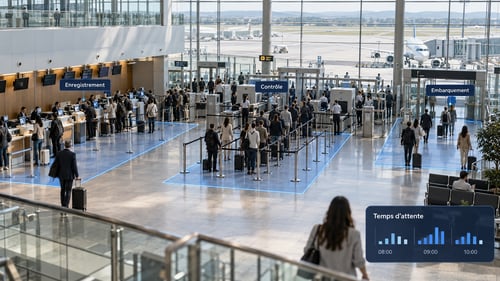
Which areas should be equipped with sensors to measure passenger traffic at the station?
Conveyors never stop without warning. They slow down, vibrate, veer off course—and no one notices. At an industrial or logistics site, a conveyor that breaks down without prior warning means a production line comes to a standstill and costs skyrocket.
Computer vision changes this equation: it allows us to interpret in real time what the infrastructure is already showing, but which the human eye cannot detect at the necessary scale.
This is a practical approach that relies on existing cameras to detect early warning signs of anomalies in conveyor systems. XXII transforms these video streams into actionable operational data—without adding any additional sensors—and while strictly respecting operators’ privacy.
This article explains how this technology works, what types of anomalies it detects, and why it is redefining the way industrial operations managers manage the reliability of their equipment.
Key Points: Computer Vision Applied to Conveyors
- Computer vision analyzes existing video feeds to identify mechanical deviations and operational anomalies on conveyors.
- This approach leverages cameras already on-site, without requiring any additional hardware installation or sensors.
- XXII’s CORE platform converts each image into actionable information to anticipate failures and reduce downtime.
- Early detection of anomalies enables a shift from reactive maintenance to condition-based maintenance, which is more targeted and less costly.
- The entire process is based on an anonymized analysis of operational data streams that complies with the GDPR and respects individual privacy.
What is computer vision as applied to industrial conveyors?
Computer vision refers to the ability of an artificial intelligence system to analyze and interpret images or videos in real time. When applied to conveyors, it involves processing video feeds captured by on-site cameras to identify unusual behavior on conveyor belts, rollers, and loading and unloading areas.
Specifically, algorithms trained on industrial scenarios detect deviations from normal operation: belt misalignment, a jammed object, an abnormal slowdown, or an unexpected buildup of material. This continuous monitoring transforms each camera into a smart sensor capable of flagging a deviation before it leads to an unplanned shutdown.
This distinction is important: the goal is not to identify individuals, but to analyze operational flows. We monitor the status of equipment, not a person’s behavior.
What types of anomalies does computer vision detect on a conveyor belt?
The anomalies that a computer vision system detects on a conveyor belt fall into three main categories: mechanical, operational, and environmental.
Mechanical anomalies include belt misalignment, visible wear on the idler rollers, and tears or incipient cracks on the conveyor surface. Operational anomalies include speed variations, localized overloads, partial blockages, or unexpected stoppages of a conveyor section. Environmental anomalies involve the presence of foreign objects on the belt, the accumulation of dust or residue, and obstructions in transfer zones.
This categorization allows maintenance teams to prioritize their interventions. Real-time video analysis that identifies the onset of misalignment gives technicians time to correct the belt’s path before it deteriorates or stops.
How does early detection via video analysis work?
The process consists of three steps: video capture, algorithmic processing, and information output. Cameras installed on-site continuously capture images of the conveyor. These video streams are transmitted to an analytics platform that applies computer vision models trained to recognize normal and abnormal conditions.
When a deviation is detected, the system generates a contextualized alert. The operator receives the information, including the precise location of the anomaly, its probable nature, and a timestamp. This feedback loop enables a response within minutes rather than hours, by which time the damage is already visible to the naked eye.
Using existing cameras speeds up deployment. According to a study published in *The International Journal of Advanced Manufacturing Technology* (2024), digital twins combined with machine learning enable high accuracy in predicting conveyor failures.
Why use existing cameras rather than adding sensors?
Installing new sensors on each conveyor segment requires a significant hardware investment, integration work, and recurring maintenance costs. Computer vision circumvents this constraint by leveraging cameras already in place at industrial and logistics sites.
This approach reduces deployment time to just a few days and avoids any disruption to operations. The platform connects to existing video streams (RTSP, H.264/H.265 protocols), and analysis begins immediately. No additional cabling is required, and there are no physical sensors to calibrate on each roller.
The result: a rapid return on investment and broader site coverage, since each camera becomes a continuous monitoring point for critical equipment.
What role does explainable AI play in conveyor analysis?
One of the barriers to AI adoption in industrial environments is the difficulty in understanding the system’s decisions. When an algorithm flags an anomaly, maintenance teams need to know why—not just that something is wrong.
Explainable AI addresses this need. Every alert generated by the platform is accompanied by visual context: the image or video clip that triggered the detection, the specific area of the conveyor involved, and the criteria that led the model to classify the situation as abnormal. This traceability of the reasoning allows technicians to validate or adjust the priority of the intervention.
XXII incorporates this requirement for explainability into the very design of its models. We do not seek to impress with algorithmic “black boxes”; rather, we aim to deliver results that are verifiable, understandable, and actionable by field teams.
How is GDPR compliance ensured in this context?
Video analysis in industrial settings raises a legitimate question: what happens to the captured images, and how can we ensure that the system does not infringe on operators’ privacy?
The answer lies in a fundamental distinction. The analysis focuses on the condition of equipment and material flows, not on identifying individuals. The system does not use any biometric techniques. The processed data is anonymized, and the images are not stored beyond the time necessary for their operational analysis.
This distinction between flow analysis and the identification of individuals is not a technical detail. It is a founding principle that shapes product decisions. XXII’s ethics committee, composed of internal and external members, ensures that every deployment complies with the requirements of the European GDPR and upcoming regulatory frameworks, notably the AI Act.
What are the concrete benefits for industrial operations managers?
For an operations manager or site manager, value is measured in terms of avoided downtime, more targeted interventions, and increased visibility into the actual condition of equipment. Early detection of a mechanical malfunction on a conveyor allows for intervention during a scheduled maintenance window rather than having to deal with an unscheduled shutdown.
In logistics, where conveyors connect receiving, sorting, and shipping areas, every minute of downtime results in measurable delivery delays. In production, a conveyor stoppage can bring an entire production line to a standstill.Video analytics in the warehouse provides a continuous monitoring capability that manual inspections cannot match in terms of frequency.
The data collected also feeds into a history of anomalies by piece of equipment, which is useful for adjusting maintenance frequencies, comparing performance across sites, and documenting replacement investments.
In conclusion: read what the conveyors are already telling us
Conveyors constantly generate signals about their operating status. Computer vision finally provides the means to read and interpret these signals and take action before an anomaly turns into a breakdown. This real-time monitoring capability, deployed on existing cameras—without identifying individuals and in compliance with regulatory requirements—redefines what it means to analyze an industrial site.
XXII is rooted in the belief that the physical world has a lot to say, and that the right technology simply needs to know how to listen—at the right time, for the right reasons.
FAQ on Computer Vision for Anomaly Detection on Conveyors
Do we need to install new cameras to analyze conveyors using computer vision?
No. XXII’s CORE platform connects directly to the video feeds from your existing cameras. Deployment requires no additional hardware and can begin within a few days, without interrupting ongoing operations.
Does computer vision replace physical sensors on conveyors?
It complements them. Sensors measure specific parameters (vibration, temperature). Computer vision provides continuous visual monitoring of the entire conveyor, detecting anomalies that traditional sensors miss, such as foreign objects or belt misalignment.
How does XXII ensure operators’ privacy?
XXII analyzes operational flows, not individuals. The system does not use any biometric techniques; data is anonymized, and images are not stored. XXII’s ethics committee oversees each deployment to ensure GDPR compliance.
What types of conveyors can be analyzed with this technology?
XXII applies computer vision to belt conveyors, roller conveyors, chain conveyors, and automated sorting systems. The CORE platform adapts to the specific configurations of each site, from logistics docks to production lines.
What return on investment can be expected from a conveyor deployment?
ROI depends on how critical your conveyors are to your operations. By reducing unplanned downtime and targeting maintenance interventions, XXII helps improve operational efficiency and lower costs associated with breakdowns, delays, and worn-out parts.